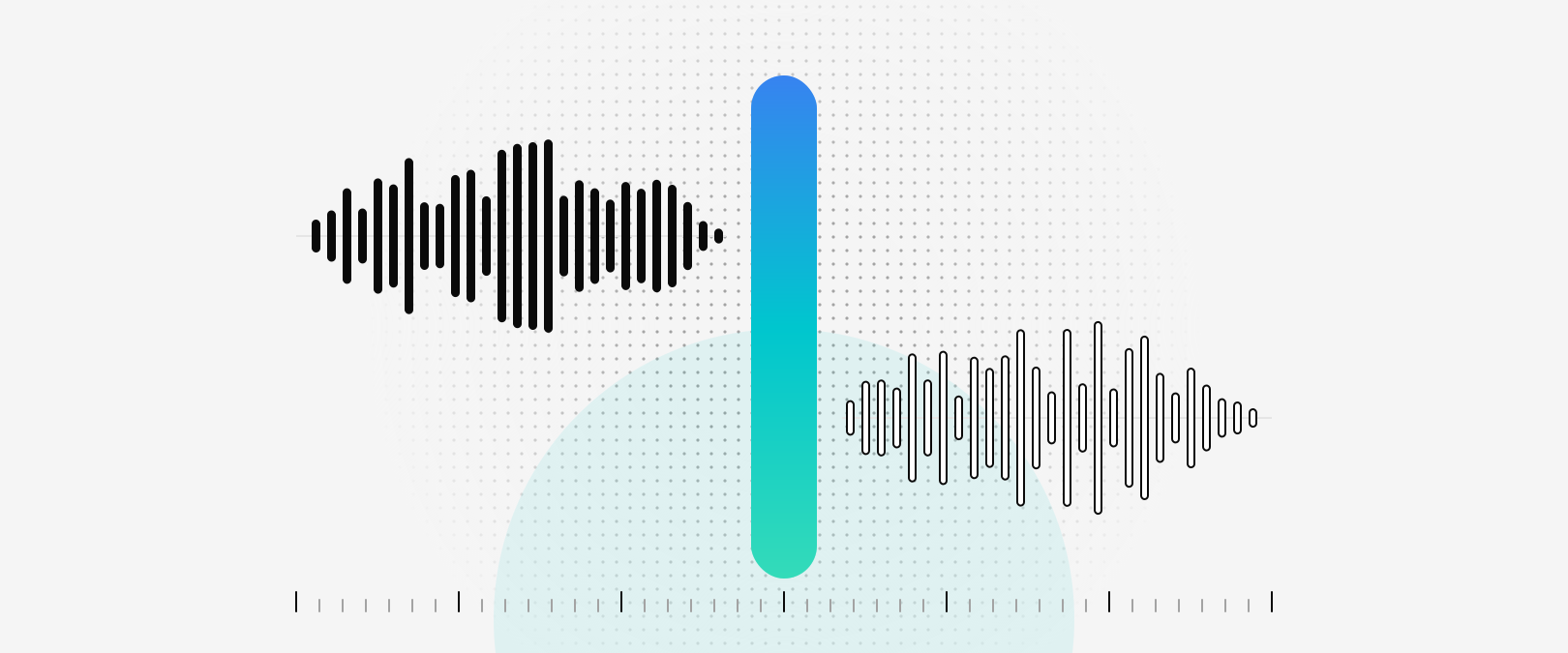
Record two people talking and measure the silences. Between one person finishing and the other starting, the typical gap is about 200 milliseconds. That is a fifth of a second, roughly the time it takes to blink.
The figure is one of the steadier results in the study of language. It also explains something anyone who has phoned an automated line already knows: a voice system can say exactly the right thing and still feel wrong.
Conversation has rules, and they are about time
In 1974 three sociologists, Harvey Sacks, Emanuel Schegloff and Gail Jefferson, published a description of how people take turns at talk. It became one of the most cited papers in linguistics. Its core observations sound obvious once stated. One person speaks at a time. Speakers change. And the change happens with very little gap and very little overlap.
That last point is the remarkable one. Nobody is directing traffic. There is no signal light. Two people, or six, manage a handover every few seconds with a precision of fractions of a second.
In 2009 Tanya Stivers and colleagues measured the timing of answers to questions in ten languages, from Danish and Japanese to languages spoken by small communities in Namibia and Papua New Guinea. The pattern held everywhere. Every language showed the same preference for answering promptly, with little overlap and little silence. The differences between cultures, including ones with a reputation for slow or fast talk, were small.
Faster than a reply can be planned
Here is the puzzle. Laboratory work on speech production shows that preparing to say even one word, from idea to the start of the sound, takes around 600 milliseconds. A full sentence takes longer.
If the gap between turns is 200 milliseconds and planning takes at least 600, listeners cannot be waiting for the end of the turn and then starting to think. Stephen Levinson and Francisco Torreira set out the conclusion in 2015: people begin planning their reply while the other person is still speaking, and they predict the moment the turn will end so they can start on time.
Conversation, in other words, runs on prediction. The listener uses grammar, meaning and the fall of the voice to project where the sentence is going, prepares an answer in parallel, and launches it at the projected end.
This is why a pause feels the way it does. The listener was ready.
What silence says
Because the default gap is so short, a longer one carries meaning.
Felicia Roberts and Alexander Francis tested this directly in 2013. Listeners heard short exchanges in which one person made a request and the other agreed. The words of the reply were identical each time. Only the silence before it changed, in steps of a tenth of a second. As the gap grew, listeners rated the speaker as less willing. The ratings began to fall at around six tenths of a second and dropped clearly past seven.
Gail Jefferson had noticed something related in recordings of everyday talk: silences within a conversation rarely run much past one second before somebody does something about them.
So a late reply is not neutral. Before any word of it has been understood, it has already been heard as hesitation, doubt or a problem. A caller who waits a second and a half for a voice agent to confirm a booking has received a message the designer never wrote.
The listener is not silent
Turn-taking is not strict alternation. While one person speaks, the other produces a steady supply of small sounds: "mm", "right", "okay". The linguist Victor Yngve named these back channels in 1970. They do not take the turn. They tell the speaker that the line is open and the message is arriving.
They matter to the speaker. In a study by Janet Bavelas and colleagues, people telling a story to a listener who was distracted, and so responded less, told it less well. On a phone call, where there is no face to read, these sounds are the only sign that anyone is there.
Speakers have their own version. Herbert Clark and Jean Fox Tree argued, from recordings of spontaneous speech, that "uh" and "um" are not noise. On their account, people use them to announce that a delay is coming, a short one or a longer one, and so keep their turn while they think.
People apply these rules to machines
It might seem that none of this should apply to software. A caller knows they are talking to a system.
Knowing does not help. In the 1990s Clifford Nass and Byron Reeves ran a long series of experiments in which people interacted with computers. People were polite to them, responded to their flattery and judged them by social rules, while insisting, when asked, that they did nothing of the kind. Nass called the finding "computers are social actors". The response is automatic.
A voice agent is therefore held to the standards of conversation from its first word, whether or not anyone designed it for them.
What this asks of a voice system
Measure time to first sound. The number that matters is the gap the caller hears: from the end of their last word to the start of the system's first. Everything between counts against it. Deciding the caller has finished, turning speech into text, working out a reply, turning the reply into speech and getting the audio down the line all spend part of the same small budget.
Know when the caller has finished. The simplest method is to wait for a fixed stretch of silence. Set it short and the system talks over people who pause mid-sentence. Set it long and every reply is late. People do not do it this way. They use the shape of the sentence and the pitch of the voice to tell a finished turn from a breath. A good system uses more than silence too.
Yield when interrupted. People overlap, notice and stop. A system that carries on with its sentence while the caller is speaking has broken the first rule of conversation, one speaker at a time. Stopping at once, and keeping track of what the caller did and did not hear, is basic conversational competence.
Say when a moment is needed. Some steps take real time. Looking up an appointment in another system cannot be done in a fifth of a second. People solve this with "um" and "let me check". A voice agent can do the same in plain words: "One moment, I am looking at the calendar." A delay that is announced is heard as work. A delay that is not is heard as trouble.
Show that it is listening. When a caller gives a long answer, such as an address or a description of a problem, a short acknowledgement at the right moment tells them to keep going.
Keep turns short. A paragraph of speech cannot be skimmed. Short turns hand the floor back sooner, which gives the caller more chances to correct a mistake early.
None of this requires a system to pretend to be a person. It can say plainly that it is an automated assistant and still be easy to talk to. What makes a call feel natural is not a human name. It is good timing.
These are the questions we work through when building inbound call handling: not only what the system says, but when.
References
- Bavelas, J. B., Coates, L., and Johnson, T. (2000). Listeners as co-narrators. Journal of Personality and Social Psychology, 79(6), 941 to 952. doi:10.1037/0022-3514.79.6.941
- Clark, H. H., and Fox Tree, J. E. (2002). Using uh and um in spontaneous speaking. Cognition, 84(1), 73 to 111. doi:10.1016/S0010-0277(02)00017-3
- Jefferson, G. (1989). Preliminary notes on a possible metric which provides for a "standard maximum" silence of approximately one second in conversation. In D. Roger and P. Bull (Eds.), Conversation: An Interdisciplinary Perspective. Multilingual Matters.
- Levinson, S. C., and Torreira, F. (2015). Timing in turn-taking and its implications for processing models of language. Frontiers in Psychology, 6, 731. doi:10.3389/fpsyg.2015.00731
- Nass, C., Steuer, J., and Tauber, E. R. (1994). Computers are social actors. Proceedings of the SIGCHI Conference on Human Factors in Computing Systems, 72 to 78. doi:10.1145/191666.191703
- Reeves, B., and Nass, C. (1996). The Media Equation: How People Treat Computers, Television, and New Media Like Real People and Places. Cambridge University Press.
- Roberts, F., and Francis, A. L. (2013). Identifying a temporal threshold of tolerance for silent gaps after requests. Journal of the Acoustical Society of America, 133(6), EL471 to EL477. doi:10.1121/1.4802900
- Sacks, H., Schegloff, E. A., and Jefferson, G. (1974). A simplest systematics for the organization of turn-taking for conversation. Language, 50(4), 696 to 735. doi:10.2307/412243
- Stivers, T., Enfield, N. J., Brown, P., and others (2009). Universals and cultural variation in turn-taking in conversation. Proceedings of the National Academy of Sciences, 106(26), 10587 to 10592. doi:10.1073/pnas.0903616106
- Yngve, V. H. (1970). On getting a word in edgewise. Papers from the Sixth Regional Meeting of the Chicago Linguistic Society.